
Abu Dhabi is one of the most extraordinary cities in the world to raise a child.
On any given morning, you might walk past a family from the Philippines, greet a neighbour from Egypt, stop to chat with a colleague from India, and share a lift with someone from the United Kingdom, Ghana, or Jordan — all before you have had your first cup of coffee.
This is not unusual in Abu Dhabi. It is everyday life. The UAE is home to over 200 nationalities, and Abu Dhabi's population reflects that beautifully. For children growing up here, diversity is not a concept taught in a classroom. It is the world they wake up in every single morning.
And yet, despite this extraordinary environment, many parents in Abu Dhabi make nursery and preschool choices based almost entirely on location, price, and hours — without fully considering one of the most powerful developmental gifts they can give their child in this city: a genuinely multicultural early learning environment.
This blog is about why that matters so much, what the research tells us about multicultural early childhood education, what to look for in a nursery or preschool that truly lives its multicultural values — and how Angels Garden on the Corniche has built one of Abu Dhabi's most beautifully diverse early childhood communities.
Why Abu Dhabi Is the Perfect City for Multicultural Early Education
Before we talk about nurseries, let us talk about the city itself — because context matters.
Abu Dhabi's expatriate population makes up the significant majority of residents. Families arrive from every corner of the world — South Asia, Southeast Asia, the Arab world, Africa, Europe, and the Americas — bringing with them their languages, their traditions, their food, their values, and their stories.
For children, this creates a learning environment that simply does not exist in most other cities in the world. A child growing up in Abu Dhabi has the opportunity to develop cross-cultural empathy, multilingual awareness, and global social skills from their very first years — before formal schooling even begins.
But this opportunity is not automatic. It depends entirely on the environments we place our children in.
A child who attends a nursery where every other child looks like them, speaks the same language, and comes from the same cultural background will not develop the same multicultural competencies as a child who grows up learning, playing, eating, and celebrating alongside children from fifteen different countries.
The nursery you choose is not just a place of safety and learning. It is your child's first social world. And in Abu Dhabi, that first social world can be one of the most globally rich and developmentally powerful environments imaginable — if you choose wisely.
What the Research Tells Us About Multicultural Early Childhood Education
The evidence on the benefits of multicultural early education is consistent, compelling, and growing stronger every year.
Language development accelerates in multilingual environments. Children who are exposed to multiple languages in their early years — even passively, simply by hearing different languages spoken around them — develop stronger phonological awareness, broader vocabulary, and greater cognitive flexibility. The brain of a young child is uniquely primed for language acquisition, and a multilingual nursery environment activates that capacity in ways that monolingual environments simply cannot.
Empathy develops earlier in diverse social environments. Research in developmental psychology consistently shows that children who interact regularly with peers from different backgrounds develop theory of mind — the ability to understand that others have different thoughts, feelings, and perspectives — earlier and more fully than children in homogeneous environments. In simple terms, diverse social environments make children more empathetic human beings.
Cognitive flexibility is strengthened by cross-cultural experience. Navigating different cultural norms, communication styles, and social expectations requires the brain to be flexible, adaptive, and creative. Children who develop this flexibility early are better problem solvers, more resilient in new situations, and more confident when facing the unexpected.
Global-mindedness is built, not born. The children growing up in Abu Dhabi today will live and work in an interconnected global world. The child who learns at age 3 that their friend celebrates Eid, their classmate celebrates Diwali, and their teacher speaks Arabic, English, and Tagalog is developing a worldview that will serve them for the rest of their lives.
These are not abstract benefits. They are measurable, documented outcomes that shape a child's cognitive and social development in lasting ways.
What to Look for in a Truly Multicultural Nursery in Abu Dhabi
Not every nursery that describes itself as "international" or "multicultural" truly lives those values in practice. Here is what to look for when assessing whether a nursery is genuinely committed to multicultural education — or simply using the word as a marketing label.
1. Diversity in the Student Community
The most basic indicator is simple — look around the classroom. Do the children come from a genuine mix of nationalities and backgrounds? Or does the nursery primarily serve one or two nationality groups?
A truly multicultural nursery in Abu Dhabi will have children from Arab, South Asian, Southeast Asian, African, and Western backgrounds learning side by side. When children from fifteen or more nationalities share a classroom, diversity is not a program. It is the daily reality.
2. Diversity in the Teaching Team
The cultural diversity of the teaching staff is equally important. Children learn not just from what teachers say, but from who teachers are. A teaching team that represents multiple nationalities, languages, and cultural backgrounds models diversity in the most powerful possible way — by embodying it.
Ask any nursery you visit: where are your teachers from? How many nationalities are represented on your team? Do your teachers speak languages other than English?
3. Multilingual Curriculum
In Abu Dhabi, Arabic is a non-negotiable part of any quality early childhood curriculum — it is both a legal requirement and a genuine educational advantage. But the best multicultural nurseries go further, offering additional language exposure beyond Arabic and English.
French, for example, is increasingly sought after by internationally minded Abu Dhabi families — both as a third language for children who already speak two, and as a gateway to European education systems for families who may eventually move.
Ask about how languages are integrated into the daily curriculum — not just as a separate lesson, but as a living part of the classroom environment.
4. Cultural Celebrations and Awareness
A genuinely multicultural nursery will celebrate the full range of cultural and religious occasions represented in its community — not just the most familiar ones. Eid, Diwali, Christmas, Chinese New Year, Holi, Easter, and many others all have a place in a truly inclusive early childhood community.
More importantly, these celebrations should be educational — helping children understand the meaning and significance of different traditions, building genuine cultural knowledge rather than just putting on a costume for a day.
5. A Community, Not Just a Student Body
The most powerful multicultural learning happens not just in the classroom but in the community around it. When parents from different nationalities know each other, share experiences, and build genuine relationships, their children grow up in a social world that reflects the full richness of Abu Dhabi's diversity.
Look for a nursery where the parent community is active, diverse, and genuinely engaged — where events, communications, and relationships bring families together across cultural lines.
Languages at Abu Dhabi Nurseries — What Every Parent Should Know
Language is at the heart of multicultural education, and it deserves special attention in the Abu Dhabi context.
Arabic is compulsory and valuable. Under the UAE educational framework, Arabic must be taught in all early childhood settings. For Emirati children, this is their mother tongue and an essential part of their identity. For expatriate children — regardless of their nationality — Arabic is a gift. It is the language of the country they live in, the language of their Emirati friends and neighbours, and one of the world's most widely spoken languages. A nursery that takes Arabic seriously — teaching it daily, integrating it naturally, and making it enjoyable — is giving every child in its care an enormous advantage.
English as a language of instruction. English is the primary language of instruction in the vast majority of Abu Dhabi nurseries and preschools, reflecting its status as the city's primary language of business, education, and international communication. For children whose home language is not English, quality early English language support is essential — including phonics, vocabulary building, and reading readiness activities.
French as a third language. French is spoken by over 300 million people worldwide and is the official language of 29 countries. For families who are internationally mobile — and many Abu Dhabi families are — early French language exposure is a meaningful long-term investment. It is also widely proven that introducing a third language in early childhood is significantly easier than introducing it later in life, particularly when the brain is already navigating two languages simultaneously.
The multilingual brain advantage. Children who grow up with exposure to multiple languages do not get confused — despite a persistent myth to the contrary. Research is overwhelmingly clear that multilingual children develop stronger working memory, greater metalinguistic awareness — meaning the ability to think about language itself — and better academic outcomes across subjects compared to monolingual peers. The early years are the golden window for language acquisition, and a nursery that offers genuine multilingual exposure is making the most of it.
Angels Garden — A Community of 15+ Nationalities on the Corniche
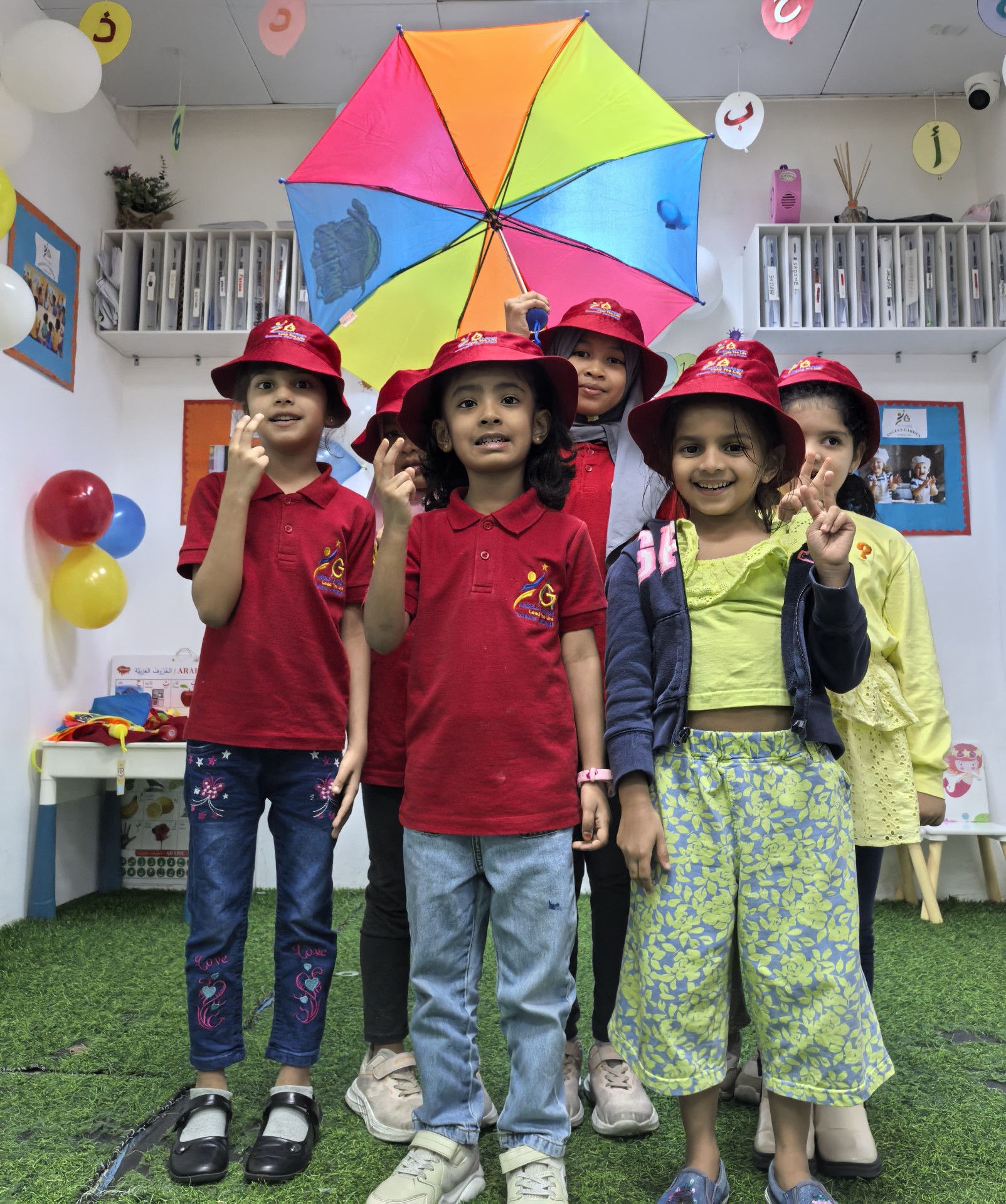
At Angels Garden, multiculturalism is not a marketing message. It is the living reality of our community every single day.
Our student body currently includes children from over 15 nationalities — Emirati, Indian, Egyptian, Syrian, Pakistani, Filipino, Turkish, Bangladeshi, Nepali, Sri Lankan, Ghanaian, Ugandan, Sudanese, Spanish, Jordanian, Palestinian, and more. Our teaching and support staff represent 9 nationalities from around the world.
When we say that different cultures, languages, and traditions grow together at Angels Garden like a beautiful bunch of flowers — that is not a metaphor we chose lightly. It is a description of what happens in our classrooms every morning.
Here is what that looks like in practice:
In the classroom, children hear Arabic, English, and French every day. They learn from teachers whose accents, cultural references, and life experiences span three continents. They make friends whose names, lunches, and family traditions are different from their own — and they learn, naturally and joyfully, that different is wonderful.
In our celebrations, we mark the full calendar of cultural and religious occasions represented in our community. Eid is celebrated with warmth and meaning. Diwali brings colour and joy. Christmas is welcomed. Cultural awareness activities happen every single Friday — because we believe that understanding the world around you is as important as any academic subject.
In our language curriculum, Arabic is taught daily as a compulsory subject — not as a box to tick, but as a genuine and valued part of every child's education. English literacy and phonics form the core of our academic curriculum. French is offered for families who want to give their child that additional language advantage.
In our parent community, families from across the world come together — at our events, through our communications, and in the daily rhythms of school life. At Angels Garden, a parent from the Philippines and a parent from Egypt and a parent from the UAE are not strangers. They are part of the same community, raising their children together.
A Message to Expat Families in Abu Dhabi
If you have recently arrived in Abu Dhabi, or if you are planning to move here, one of the most important things we want you to know is this:
Your child's time in Abu Dhabi is an extraordinary gift — if you let it be.
The diversity of this city, the richness of its cultural landscape, the opportunity for your child to grow up as a genuine citizen of the world — these are things that most children, in most cities, will never have. Do not let the busyness of the move, the practicality of the school search, or the comfort of choosing what is familiar cause you to miss what is truly available here.
Choose a nursery or preschool where your child will be surrounded by the full diversity of Abu Dhabi. Choose a place where Arabic is taught with genuine commitment. Choose an environment where your child's cultural background is celebrated — and where they will celebrate the backgrounds of every friend they make.
That choice will shape your child's worldview, their empathy, their cognitive development, and their sense of belonging in ways that last a lifetime.
A Message to Emirati and Local Families
For Emirati families and families who have been in Abu Dhabi for many years, the question of multicultural education is equally relevant — perhaps even more so.
Your children are growing up in a country that defines itself by its openness to the world. The UAE's founding vision was built on the idea that different peoples, faiths, and cultures can live together, respect each other, and build something extraordinary together. That vision is most powerfully passed on not through textbooks, but through the daily lived experience of childhood.
A child who grows up with friends from 15 nationalities understands that vision from the inside. They do not just know it intellectually — they feel it, they live it, and they carry it forward.
At Angels Garden, Emirati children and expatriate children learn side by side every day. Arabic is at the heart of our curriculum. UAE culture and values are woven into everything we do. And the world — in all its beautiful diversity — is present in every classroom.
Location and Contact
Angels Garden
Corniche Road, Abu Dhabi, UAE — 3 minutes from WTC Mall
WhatsApp & Mobile: 055 410 7828 · Landline: 02 676 3149
enquire@angelsgarden.org
School Hours
Monday – Thursday: 9:00 AM – 1:30 PM
Friday: 9:00 AM – 11:30 AM
Centre Hours (Daycare & Services)
Monday – Friday: 7:00 AM – 9:00 PM
Saturday – Sunday: 9:00 AM – 7:00 PM
Final Thoughts
Abu Dhabi gives your child a gift that most cities in the world simply cannot offer — the chance to grow up in one of the most diverse, culturally rich, and internationally connected communities on earth.
The nursery or preschool you choose either unlocks that gift or leaves it unopened.
At Angels Garden, we have built a community where over 15 nationalities learn, play, and grow together — where Arabic, English, and French fill the classroom, where every cultural celebration is an opportunity to learn, and where every child graduates from their early years with a worldview as wide as the world itself.
Come visit us on the Corniche. See our community for yourself. And give your child the multicultural start they deserve.
Related Guides for Abu Dhabi Parents
📌 Book a free visit or your child's free trial class today
Call or WhatsApp us on 055 410 7828, or email enquire@angelsgarden.org. We are open 7 days a week and always happy to welcome new families from every corner of the world.